


AI, Mental Health, and the Great Uncontrolled Experiment: Are We Moving Faster Than Science Can Protect Us?

Artificial intelligence is entering daily life at extraordinary speed, raising an important question: are we integrating technologies that shape human psychology faster than we can understand their consequences? History suggests this is possible. Social media offers a clear precedent. Platforms became deeply embedded in the lives of children and adolescents long before developmental psychology, neuroscience, and public policy fully understood their effects. Only later did research begin to clarify concerns around problematic engagement, sleep disruption, social comparison, cyberbullying, compulsive use, anxiety, and depression. The lesson is not that technology is inherently harmful, but that innovation often outpaces our ability to study behavioural consequences.
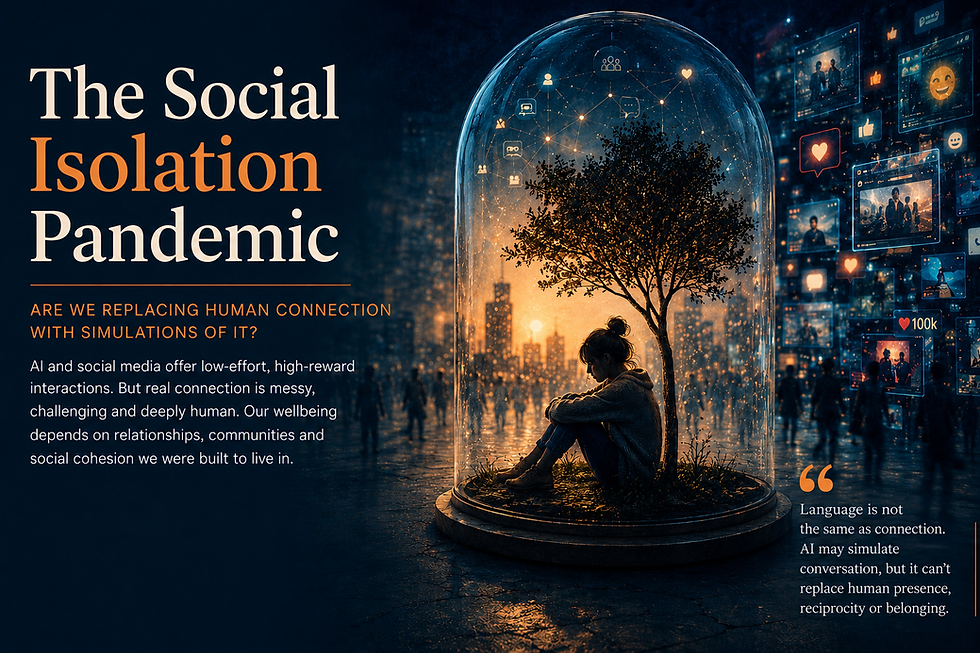
Artificial intelligence may present an even more complex challenge because it is not simply a medium for consuming information. It is interactive. Social media largely shaped what we viewed and how we compared ourselves to others. AI systems can converse, adapt, provide immediate responses, simulate empathy, offer reassurance, and appear attentive or understanding. Whether these systems truly “understand” is less important than the psychological reality that many users may experience them as relational. Humans readily anthropomorphise technology, particularly when interaction feels natural, emotionally responsive, and personalised.
This raises particular concerns for children and adolescents. Young people are developmentally more sensitive to novelty, reward, social approval, and emotionally compelling experiences, while executive control, metacognitive awareness, and emotional regulation are still maturing. AI systems are, in many ways, optimally structured to engage these vulnerabilities. They are immediate, frictionless, endlessly available, and capable of adapting to individual users. A distressed adolescent may find it easier to speak to an AI than to a parent, teacher, or peer. That accessibility may feel helpful, but accessibility alone does not equal safety.
Early evidence suggests this is already occurring. McBain and colleagues (2025) found that adolescents and young adults are already using generative AI for mental health advice, with many reporting it as helpful. This is understandable, but also concerning. AI may inadvertently become a mechanism for emotional outsourcing, where individuals increasingly rely on a machine for reassurance, comfort, clarification, or emotional processing rather than developing distress tolerance, interpersonal coping skills, or healthy uncertainty management. Golden and Aboujaoude (2026) have argued that general-purpose AI chatbots may reinforce known anxiety-maintaining mechanisms such as reassurance seeking, compulsive checking, perfectionistic information loops, and intolerance of uncertainty.
For adolescents, identity formation presents another significant concern. Development during adolescence involves questions of self-concept, belonging, emotional meaning, and personal identity. If young people increasingly ask AI systems questions such as “Do I have ADHD?”, “Am I autistic?”, “Why do I feel different?”, or “Is something wrong with me?”, then AI becomes part of the meaning-making process around identity. This is a profoundly underexplored issue. AI may not merely provide information; it may begin to shape how young people understand themselves.
There are also broader developmental questions around cognition and learning. AI increasingly reduces effort associated with memory, writing, planning, problem-solving, and tolerating uncertainty. For adults, this may improve efficiency. For developing minds, the long-term effects are much less clear. If frustration is repeatedly bypassed, uncertainty instantly resolved, or effortful cognition outsourced, what happens to persistence, executive functioning, or reflective reasoning? We do not yet know.
The comparison with social media remains useful here. Social media taught us that technology can become developmentally embedded long before research catches up. AI may compress that timeline dramatically. The difference is that AI is not merely content exposure. It is interaction, dialogue, and increasingly relational simulation. That changes the ethical landscape significantly. We are no longer simply asking what children are consuming online. We are asking what kinds of relationships they may form with adaptive technologies, how emotional regulation may be shaped, and whether developmental processes are being influenced by systems we do not yet fully understand.
This does not mean AI is inherently harmful. Carefully designed AI interventions in mental health may indeed offer meaningful benefits. But consumer-facing general AI systems are not equivalent to structured clinical tools. The concern is not panic, but caution. If social media taught us anything, it is that technological enthusiasm should not replace rigorous developmental science. The question is whether we are once again conducting a large-scale uncontrolled experiment, this time with technologies that do not simply capture attention, but actively participate in human psychological life.

References
McBain RK, et al. (2025). Use of Generative Artificial Intelligence for Mental Health Advice Among US Adolescents and Young Adults. JAMA Network Open.DOI: 10.1001/jamanetworkopen.2025.42281
Golden J, Aboujaoude E. (2026). A transdiagnostic model for how general-purpose AI chatbots may perpetuate anxiety and obsessive-compulsive disorders. npj Digital Medicine.DOI: 10.1038/s41746-026-02531-7
Keles B, McCrae N, Grealish A. (2020). A systematic review: the influence of social media on depression, anxiety and psychological distress in adolescents. BMC Psychology.DOI: 10.1186/s40359-020-00437-1
Odgers CL, Jensen MR. (2020). Annual Research Review: Adolescent mental health in the digital age. Journal of Child Psychology and Psychiatry.DOI: 10.1111/jcpp.13190
U.S. Surgeon General Advisory (2023). Social Media and Youth Mental Health.
National Academies of Sciences, Engineering, and Medicine. (2024). Social Media and Adolescent Health.


Comments