


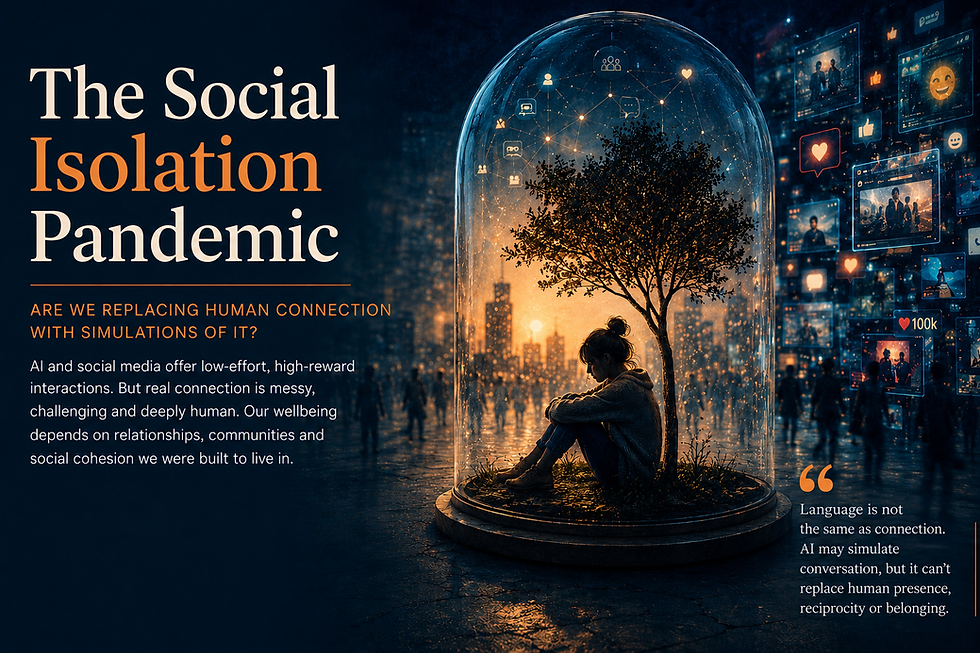
The Social Isolation Pandemic: Are We Replacing Human Connection with Simulations of It?

We live in one of the most technologically connected periods in human history, yet many people appear to feel increasingly disconnected from one another in ways that matter profoundly for psychological wellbeing. Loneliness, alienation, and social fragmentation are now recognised as major public health concerns despite unprecedented access to communication technologies, social media, instant messaging, video interaction, and increasingly sophisticated artificial intelligence systems capable of highly responsive conversation.
This concern is not merely anecdotal. The World Health Organization has explicitly identified loneliness and social isolation as significant global public health concerns, recognising social connection as a critical determinant of health, wellbeing, and longevity. Similarly, the U.S. Surgeon General has described loneliness as a growing public health epidemic, highlighting its association with depression, anxiety, cardiovascular disease, poorer physical health outcomes, cognitive decline, and even premature mortality. This presents an uncomfortable paradox: how can we be so technologically connected, yet increasingly psychologically alone?
One possible answer is that not all forms of connection are equivalent. Human beings evolved within deeply social environments in which survival depended on reciprocal relationships, cooperation, social belonging, and embodied interpersonal engagement. Our nervous systems, emotional regulation capacities, attachment systems, and social cognition did not develop through abstract communication alone, but through lived relational experience. Real human interaction is effortful. It involves ambiguity, misunderstanding, emotional discomfort, negotiation, frustration, vulnerability, patience, conflict, and repair. Relationships can be deeply rewarding, but they are also cognitively and emotionally demanding. Importantly, this complexity is not a flaw in human connection, it is part of what makes it psychologically developmental.
Attachment theory and developmental psychology have repeatedly demonstrated that emotional wellbeing emerges through embodied, contingent, reciprocal relationships. From infancy, secure attachment is built through repeated experiences of responsiveness, eye contact, facial expression, tone of voice, proximity, touch, emotional attunement, and co-regulation. Human development is shaped not simply through words, but through relational presence. This distinction matters because many modern technologies increasingly provide the experience of social engagement while stripping away many of the features that make human interaction psychologically formative.
Social media and artificial intelligence offer something inherently attractive: socially meaningful experiences at a lower interpersonal cost. Social media provides immediate validation, stimulation, distraction, and a sense of social participation without necessarily requiring vulnerability or genuine reciprocity. AI systems can appear endlessly patient, responsive, affirming, emotionally available, and free from the unpredictability or demands that accompany real human relationships. These interactions can feel rewarding precisely because they are more manageable. They are cleaner, more controlled, and often far less emotionally taxing than embodied social life.
This intersects with the concept of the parasocial relationship, a phenomenon in which individuals form one-sided emotional bonds with media figures, celebrities, influencers, or increasingly, digital systems. Traditionally, parasocial relationships emerged through television and celebrity culture, where individuals developed feelings of familiarity and attachment toward public figures who did not know them personally. Social media has amplified this dramatically by creating the illusion of intimacy, accessibility, and mutual familiarity. AI may take this a step further by offering interactive systems that simulate personal engagement, emotional understanding, and conversational reciprocity. While these experiences may provide comfort, distraction, or even short-term companionship, they remain fundamentally different from reciprocal human relationships grounded in shared vulnerability, accountability, and lived mutual experience.
The concern is not that these technologies are inherently harmful. The concern is substitution.
Human beings are highly responsive to efficient reward systems. We are naturally drawn toward experiences that offer reinforcement with lower effort, less discomfort, and more predictable outcomes. If social interaction becomes increasingly available in forms that are less demanding, less ambiguous, and more immediately rewarding, it is unsurprising that these options become appealing. Yet over time, this may weaken precisely the capacities that psychologically healthy social functioning requires. Our tolerance for awkwardness, disagreement, frustration, uncertainty, boredom, emotional unpredictability, and the effort involved in maintaining real relationships may gradually diminish if these experiences are increasingly avoided.
From a behavioural perspective, this resembles a large-scale shift in reinforcement contingencies. If difficult but meaningful social engagement is replaced by easier, immediately rewarding digital alternatives, then avoidance may become increasingly reinforced while richer interpersonal behavioural repertoires narrow. Put simply, if we consistently choose lower-effort substitutes for connection, we may become less capable of engaging in the complex social realities human wellbeing depends upon.
This concern may be especially important for younger generations. Adolescence is not simply a period of consuming information or entertainment. It is a critical developmental window in which identity formation, emotional regulation, peer negotiation, empathy, autonomy, and social cognition mature through lived relational experience. Awkwardness, rejection, belonging, exclusion, uncertainty, and conflict are not incidental experiences in adolescence; they are part of developmental learning. If these experiences are increasingly displaced by sanitised, algorithmically curated, or performative digital engagement, important developmental questions emerge.
What happens when conflict can be escaped instantly? When reassurance becomes immediately available? When social comparison is constant? When interaction becomes performative rather than embodied? When young people increasingly turn to artificial systems for support, reassurance, or pseudo-companionship? These are not arguments against technology itself, but questions about what may be displaced when technology becomes the dominant medium of social life.
These concerns are not merely theoretical. Loneliness and social isolation are strongly associated with depression, anxiety, poorer stress regulation, cardiovascular disease, reduced wellbeing, and even increased mortality. Research on social media remains nuanced, but problematic patterns of use have been associated with poorer mental health outcomes, particularly among adolescents and young adults. Importantly, the strongest question may not simply be whether social media or AI are harmful in themselves, but what forms of human interaction they may be replacing.
A further irony is that technology is increasingly being proposed as the solution to the very problems it may sometimes be contributing to. AI companions, mental health chatbots, digital therapeutic tools, and automated support systems may offer genuine utility, particularly where access to care is limited. However, if the underlying difficulty is one of social fragmentation, weakened community cohesion, alienation, and diminished embodied relational life, then technological substitution may misunderstand the nature of the wound. Mental health is not merely an individual cognitive phenomenon that can be resolved through language alone. It emerges within social, relational, developmental, and contextual systems of belonging.
Language matters, but human wellbeing is not built through language alone. Humans are embodied relational organisms. We develop through presence, reciprocity, challenge, emotional repair, social learning, and shared lived experience. AI may simulate aspects of conversation remarkably well, but simulation is not synonymous with attachment, belonging, intimacy, or genuine human connection.
This is not an argument for rejecting technology. Technology can enhance communication, facilitate access, and provide meaningful support in many contexts. But we should be cautious about replacing psychologically necessary forms of human engagement with efficient approximations of connection that feel satisfying in the short term while gradually weakening the social capacities on which long-term wellbeing depends.
Human relationships are often inconvenient, effortful, emotionally demanding, and imperfect. Yet those very qualities may not be defects to engineer away. They may be part of what keeps us psychologically human.
References
Bowlby, J. (1969/1982). Attachment and Loss: Volume 1. Attachment.
Ainsworth, M. D. S., Blehar, M. C., Waters, E., & Wall, S. (1978). Patterns of Attachment.
Hawkley, L. C., & Cacioppo, J. T. (2010). Loneliness matters: A theoretical and empirical review of consequences and mechanisms. Annals of Behavioral Medicine, 40(2), 218–227. https://doi.org/10.1007/s12160-010-9210-8
Cacioppo, S., & Cacioppo, J. T. (2018). The growing problem of loneliness. The Lancet, 391(10119), 426. https://doi.org/10.1016/S0140-6736(18)30142-9
Odgers, C. L., & Jensen, M. R. (2020). Annual Research Review: Adolescent mental health in the digital age. Journal of Child Psychology and Psychiatry, 61(3), 336–348. https://doi.org/10.1111/jcpp.13190
Twenge, J. M., Joiner, T. E., Rogers, M. L., & Martin, G. N. (2018). Increases in depressive symptoms and suicide-related outcomes among U.S. adolescents after 2010. Clinical Psychological Science, 6(1), 3–17. https://doi.org/10.1177/2167702617723376
World Health Organization. (2025). Social connection and loneliness.
U.S. Surgeon General. (2023). Our Epidemic of Loneliness and Isolation.


Comments